


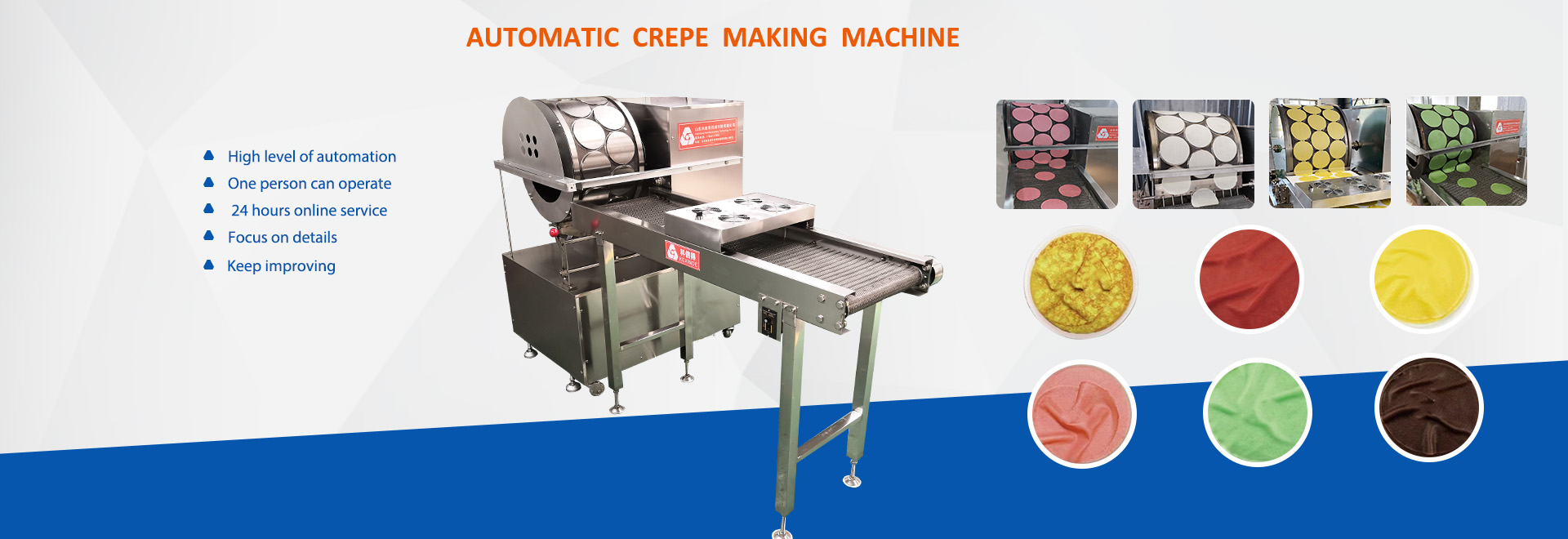

When purchasing a crepe machine, it is not advisable to blindly compare prices. To ensure stable production of crepes, high product qualification rate, and compatibility with the production line, precise selection based on five core dimensions - slurry composition, water absorption adaptability, cake skin shape and size, hourly production capacity, and heating method - is necessary. These are the key criteria for food processing plants when choosing crepe equipment.
1. Selecting based on slurry composition and water absorption (selection basis)
Different crepe slurry formulations directly determine the scraping speed of the equipment, temperature control parameters, and shaping effect.
There are mainly two types of slurries available on the market: flour-based slurry and egg-based slurry.
2. Confirming the shape and precise size of the crepe
Before purchasing the equipment, it is necessary to determine the production mold. It is mainly divided into two categories: circular crepe and square crepe. The molds cannot be used interchangeably:
1. Circular crepe: The specific diameter size must be determined. Common standard specifications can be customized for fine-tuning to ensure uniform circumference and consistent thickness;
2. Square crepe: The precise parameters of length and width must be confirmed.
3. Matching hourly production capacity
Based on the factory's order volume and production line configuration, select an appropriate hourly production capacity.
The capacity of crepe machines varies greatly. From small-scale mass production to large-scale industrial production, customizations are available. Reasonable capacity matching can avoid the equipment being too small to keep up with the production rhythm and prevent overcapacity from causing energy waste, ensuring the efficient and stable operation of the entire production line.
4. Selecting the appropriate heating method
The core of crepe formation and maturation lies in the heating system. Currently, there are three mainstream heating methods with their respective advantages. Choose according to your needs:
1. Electric heating: Precise temperature control, uniform temperature, clean and environmentally friendly, low failure rate, suitable for most small and medium-sized food factories;
2. Gas heating: Fast heating speed, low operating cost, suitable for large-scale mass production, and factories with gas conditions in the workshop;
3. Electromagnetic heating: High heat efficiency, uniform heating, energy-saving and power-saving, long service life, suitable for high-standard dust-free workshops.
Post time: Nov-13-2026